Relationships as a Source of Importance

Before Twitter.

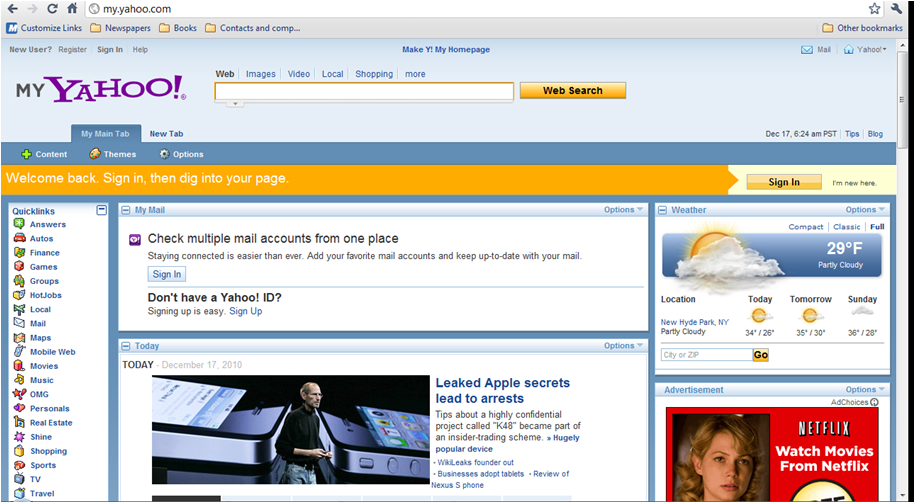
I was an early adopter of myYahoo.  I built highly organized tabbed pages on all things that were important to me.  It didn’t bother me at the time that I had to decide what was important to me.  In fact, I felt empowered that I got to decide rather than some pre-historic layout editor deciding for me.  This was revolutionary for our industry.

My tabbed pages included included headline news, business news, technology news, news on specific companies including their stock price, score of my favorite sports teams, weather in locations that I frequent or where business friends live, and some cartoons.  My myYahooo page became habitual.  I would look at it once a day – either first thing in the morning or last thing before signing off.  It was embedded in my daily routine.   It was the tool that answered the question, “what is going on around me that I care about”?  It was the ultimate of what Yahoo wants to accomplish with their information services.
After Twitter.

Well, I just realized that myYahoo is no longer habitual.  I only go there now for Yahoo Finance where I have nicely organized portfolios of every public company in every software industry segment.  Yahoo Finance still does a great job with drill down into public company specifics.

Twitter is the new habit that has replaced myYahoo as the information service that answers the question “whats going on around me?”.  And unlike myYahoo, I don’t even have to decide the topics or sources.  I just follow people in Twitter from a variety of different disciplines whose opinions and insights I value.  That is so simple and easy.  So as they tweet on topics important to them, those same topics are likely to be important to me.  I feel better informed now using this service than I was previously using myYahoo.

Given the success of Twitter, and my own experience of willingly delegating “importance” to those that I follow, I have to conclude that relationships are a better source of importance than my own judgment.
Its a Cadillac.

If you were looking for a great example of a premium product, offering premium value, sold at a premium price, what brand name do you think of?  And conversely, what is the brand at the opposite (i.e., low) end of the spectrum?

I’ve been laughed at a few times recently when in conversation, to describe such a product, I’ve used the term “Cadillac” as that reference point.

“Bill, don’t you realize that most people under 40 have no affinity with the brand Cadillac, or that it stands for premium, if they even know it at all.  Oh yea, and remember that General Motors is in financial distress.”  More laughter (at Bill).

Yet twenty years ago; maybe even ten years ago, that expression would be spot on.  I guess old (expression) habits are hard to break.

So I surfed a bit on this topic stumbled upon the blog post  What makes a premium brand premium? by David Murphy, a brand strategist.  He says we are willing to pay more for a premium product or service despite other offerings providing equivalent function because…

…a premium brand is built upon specific tangible and intangible attributes that give it a sense worth:

  • Sensuality — it is sensory, tactile and a bit mysterious.
  • Rarity — it represents a discerning choice, intriguing because it is uncommon.
  • Confidence — it projects a feeling of intrinsic worth.
  • Authenticity — is has a sense of “true north” and remains true to this ideal.
  • Quality — it is consistent and shows extreme attention to detail.

Makes sense.  And I still associate each of these attributes to Cadillac.  But in my next conversation, I’m going to try a different premium brand to see what reaction that incites.

SWOT and SWAT


I had an amusing encounter recently while working on strategy planning for two different clients (yes, I am easily amused).   One client was focused on their SWOT.  The other was focused on SWAT.

A SWOT is a common planning framework – a 2×2 grid that identifies Strengths, Weaknesses, Opportunities, and Threats.  Its a popular framework because its easy to understand.  But at the same time, it on its own usually doesn’t produce useful insights.  I follow a LinkedIn discussion group on strategy planning and there was a recent vigorous debate on the merits of SWOT as a planning tool.  The conclusion in this thread, like many things, is that a SWOT exercise can be a valuable and worthwhile exercise, but is not a panacea for strategy planning.

A SWAT strategy is something different.  SWAT stands for “Sell Whats Available Today”.  All to often, we get excited about selling that next great thing and forget that we’ve already got lots of great things to sell.  Its an interesting exercise to do growth planning using the constraint of no new innovations or product development.  That constraint forces your growth strategy to focus on the market, customers, pricing, and competition.  Suddenly your debating target segments, value propositions, under-served markets, new pricing models, geographical expansion, competitive positioning, etc.

So both SWOT and SWAT are interesting strategic framework tools.   I’m guessing most organizations have spent too much energy on their SWOT and not enough energy on a SWAT.

My Sentimental Dictionary and Apps

The next edition of the Oxford English Dictionary (OED) may be only available online and not in print form, according to the publisher in this recent article.  This is a sentimental milestone from a past research project at the University of Waterloo to apply search and SGML to tag the Oxford English Dictionary and automate the work of lexicographers.  That research project was the genesis of my former employer Open Text Corporation.

The article cites the obvious, it is easier to use the OED online than in printed form (the dictionary now weights more than 130 pounds).

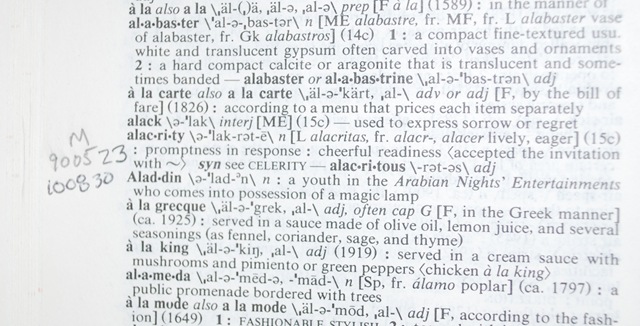
I use www.dictionary.com nearly everyday (its easier to remember than Oxford’s www.oed.com).  Before that, I used Webster’s Ninth Collegiate which was given to me as a high school graduation gift.  In my first class as a college freshman at Ohio State, the English professor opened his lecture by challenging the entire class to annotate their dictionaries with words you didn’t know.  Being anal retentive and an eager over-achiever, I embraced that recommendation and wrote codes and dates in the margin next to every word I ever looked up.  It was later in life while working on legal discovery systems, that I learned the technical term for this is “marginalia“.

So my marginalia coding scheme was very simple —  M stood for meaning and S for spelling — followed by the date.  I annotated religiously the remainder of my college and beginning of my work career.  Remember we’re talking the early 80’s before PC’s and spell check were common in the workplace.  This strange habit provided amusement for my wife and workmates.  When asked, “Why do you do that?”, it just inspired me to continue this strange habit.

The OED news caused me to peruse my old dictionary.  I had trouble spelling the word “enamor” as I looked that up on three different times in 1994.  My ideas couldn’t come to “fruition” because I looked up its meaning on May 23rd, 1990.  Dictionary alacrity I know (now) I can never remember when to use “affect” and “effect”, so I expected to see markups next to those terms but surprisingly found none.  Evidently I made frequent “inadvertent” (looked up on Sept 17th, 1986 for spelling) errors using “affect” and “effect”. I looked up the word “alacrity” on May 23rd, 1990 for meaning – the same day as “fruition”.  Hmmm.  I still don’t know what that word means so I added a new entry for Aug 30th, 2010.  You might also grin about the six-digit programmer’s date format I used.

Now fast forward to today and our emerging world of social networks.  I don’t use my tattered dictionary any longer as www.dictionary.com is an easy mouse click away, and can be integrated to web applications in many ways.   These folks have the mega annotation scheme – way better than my crude S for spelling and M for meaning scheme.  Their social dictionary has insights gleaned from an entire community of users, instantaneously, in ways that can be monetized today, and with monetization potential they haven’t even thought of.  Their insights should include trends around language usage, patterns, slang, and culture.

George Colony of Forrester recently commented about the next wave of the internet being application focused, not search focused.  He is correct.  Every traditional habit where we act individually will be replaced by a more powerful social application that will accomplish the same objective and much more.  We already see this in our daily life.  Photos are already shared more broadly in FlickR than in a dusty scrapbook; your iTunes music playlist for your July 4th picnic was influenced by the attendees, OpenTable helps you decide on a restaurant choice based on recommendations of others, and then makes your reservation.  You will have control of all your home appliances from your smartphone.  And in a business context, the next phase of automation will be realized, for example, when the oil pressure gauge on an airplane will schedule the next available mechanic and start contingency planning for the gate agents all without human intervention.  We’ve only witnessed the beginning.

The “Really Really Like” Button

I am not one of those Facebook users that Likes every page they come across.  I really really need to Like it.  I thought I would share two Really Really Like Fan pages of organizations doing a great job of engaging their customers with their product, and consequently in their brand.  OK, maybe that isn’t true.  Lets just say they are doing a great job of engaging me in their brand.

Oreos.

I love Oreos.  I am a fan of the Oreo Facebook page along with 8.9 million  other people.   The level of engagement on the Oreo fan page is impressive.  The Oreo brand managers are swimming in a wealth of authentic insights from their customers unlike any kind of market research they could have previously conducted.

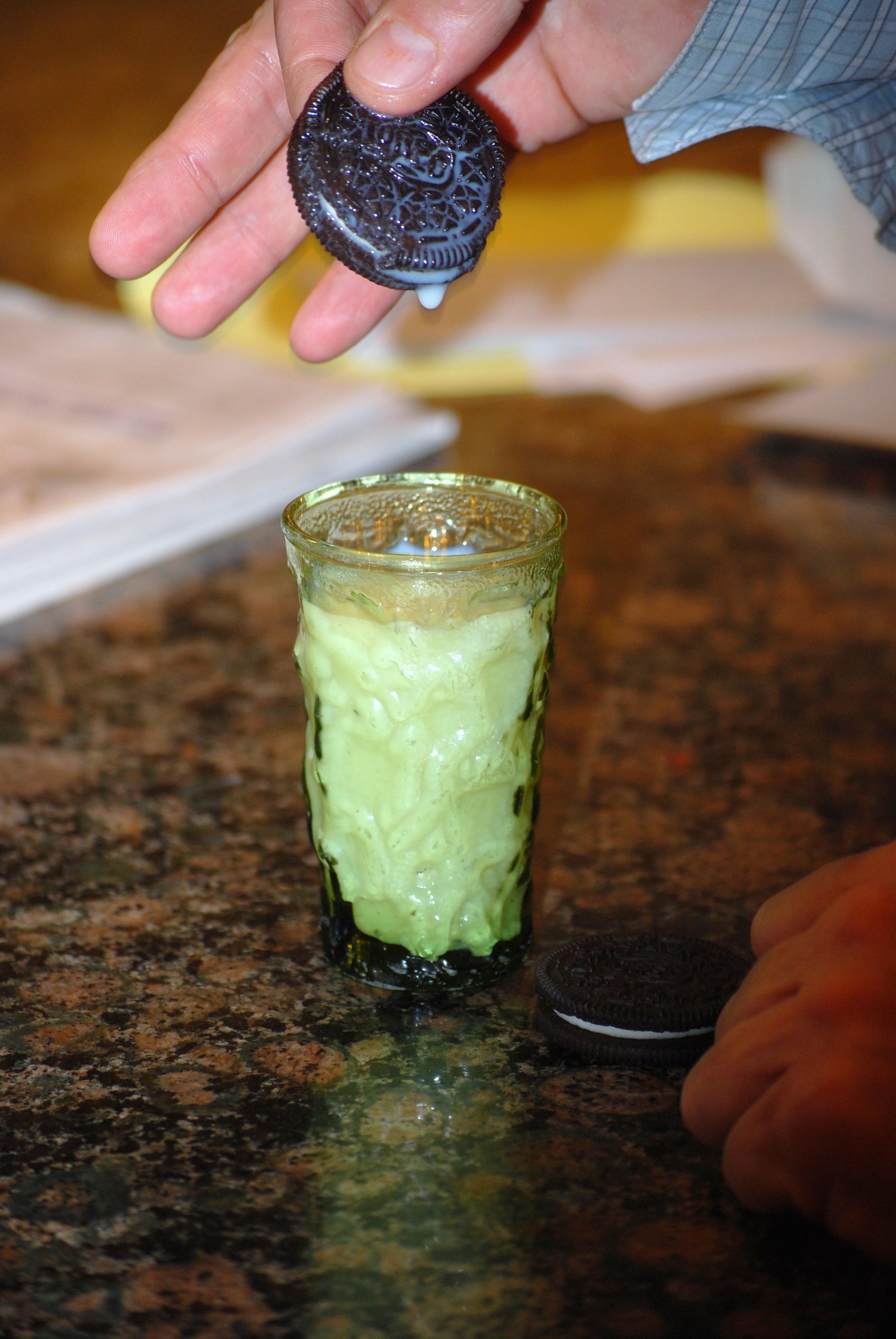
A recent post asks, “Sometimes it’s not who you share an Oreo with, but where.  What’s your favorite place to have an Oreo?”  As of this writing, 2,847 fans left comments on their favorite place.  Imagine this information being used to help design sets or locations used in advertising, or messaging in the advertising that enhances the experience of that location.  And for me, its standing around the kitchen island using a green juice glass from my childhood whose rim is just wide enough to fit an Oreo.

Dunking an Oreo in my favorite glass.

There are other fun and provocative threads.  “If milk could talk, what would it say to an Oreo?”   Over 6500 people left funny, sexual, and silly responses to that question.  Then they reversed it and asked, “What would the Oreo say to the milk?”  Need an off-color laugh?  Its worth reading a few of these comments.

Personally, I’ve only contributed to the dialogue on Oreo dunking techniques, which I have some very strong opinions.  Oreos have an entire page dedicated to “Dunk vs. Don’t Dunk”.   Obviously, this is an extremely pressing issue for our society and one which I have strong feelings given that I’ve been perfecting my dunking techniques over the last fifty-two years.

Market research?  The folks behind Oreos seem to be executing it quite well.

O-H-I-O.

Spelling is a big deal to people from Ohio, especially as football season approaches.   Script Ohio is a tradition of  The Ohio State University marching band started in 1936 that still sends chills up my spine.  Another more interactive ritual is shared throughout the world.  When strolling down the sidewalk sporting any garb from The Ohio State University and you spot someone oncoming also sporting Ohio State garb of any form,  it is customary, actually expected, that one of you will blurt out “O-H” and the other knows to answer “I-O”.  It is universal.

But recently OSU has done a great job of cultivating all this spelling into an extremely engaging “Share Your Pride” program.  Over 5800 people have shared their pride thinking of clever ways to spell O-H-I-O.  Its easy to post.  And through Facebook, it is easy to follow a featured photo everyday, which I really look forward to seeing.  Here are three of my favorites chosen especially for my Canadian friends: CN Tower, Stanley Cup, and Innocent Canadian Bystanders.  Everyone of these people feels strong enough about the brand of Ohio State to plan a clever photo, submit to the university, and be thrilled seeing their work prominently displayed publicly.  And the cost to implement?  Nearly zero (as is evidenced by their weak user interface to navigate the photos).  The value returned?  Priceless.

What About You?

I’m curious.  What brands do you love and have done a great job of engaging you?  And wearing their t-shirt doesn’t count as that isn’t nearly engaging.

Internet Television


My Ustream Broadcasting Experiences

I had the opportunity to learn more about UStream as a business earlier this year.  What Youtube is to recorded video, UStream wants to be to live streaming video.  It is internet television.  As part of my learning, I obviously needed to become a user of the service.

It takes about 2 minutes to set up your own broadcasting channel in UStream.  I’ve completed two broadcasts this past year.  First was to broadcast an Operation Feed benefit party we hosted at our house.  The invitees were all former colleagues, so I thought out-of-towners would enjoy attending virtually (they didn’t attend by the way).  The second broadcast was providing roving reporter highlights of a recent Soap Box Derby rally here in Columbus.  No one watched this live either. The production for the derby was quite minimalist, as I accomplished everything using the Ustream app on my new Motorola Droid phone (not the X). 

These were both amazingly simple to set up.  But they obviously aren’t amazingly simple to attract viewers, or to produce quality content.  That takes lots of old-fashioned creativity, thought and promotion.   But the point is, the barrier to entry in television broadcasting is approaching $0, as you are already in possession of all the equipment required to get started.   And the next time, I will work harder to promote the broadcast and create better content.

You can go to Ustream’s site and see all the broadcasts that are currently live.  You should try it.  At the time of this writing, over 4000 people are watching Molly the Barn Owl and 2000 people are watching a cricket match between India and Sri Lanka.   You will also find some incredibly poor quality broadcasts (content-wise) just like my first two attempts. 

But clever people will figure out promotion, quality content, and the other requirements to create successful new businesses or marketing programs around this capability.  So just as cable ate into the market of network television, internet television will soon eat into cable’s market share.  The internet created the channel for everyone to become a newspaper publisher.  FlickR provided the channel for amateur photographers to license and distribute stock photography.  And now  Ustream is creating the channel for you and me to be in the television broadcasting business. 

First Post! Welcome.

Welcome to There is No Someday. If you have ever started a sentence with “Someday, …”, then this blog is for you.

This past year, I eliminated one of my Somedays by starting a second career. I had spent 29 years in enterprise software and was ready for a change. I didn’t complain (much) during those 29 years. And if I did, it was about traveling so much and missing my family. I couldn’t have asked for a better 29 years. I was fortunate to begin my career as a senior in college with some visionaries at Battelle who developed software to support research and library environments. We had some very nice success in the early eighties. Our software ran well on Digital’s VAX computer system and lots of research departments shunned mainframes and bought VAXs in that era. We were a commercialization darling of Battelle who spun us out as a wholly owned subsidiary Information Dimensions, Inc. (IDI).

We mostly hired kids right out of college. Mix young enthusiasm X right product X right time and you get an incredible result. The eighties were an awesome ride upward. But when Digital smashed into a brick wall in 1990, IDI caught its own turbulence of tough times and ownership changes before eventually joining forces with Open Text Corporation in 1998 which allowed employees and customers to take another ride upward. From that time, the growth oriented Open Text grew from $60M to $1B. That was a lot of fun and I feel blessed to have had such a great opportunity provided to me.

Nevertheless, the itch to try something new and revolutionary prevailed, and my career change is now in full gear. I’m hanging out a shingle as a strategy consultant for both established companies and startups. I’ll refine my subset of “strategy” in due time. Hopefully, I’ll find most of those companies here in Ohio and I’ll loose my Super Platinum Elite United Marriott status.

My ambition for this blog is to share my experiences in strategy and planning, both in business and personal life, that might help companies, families, friends, or individuals eliminate a Someday or two of their own.